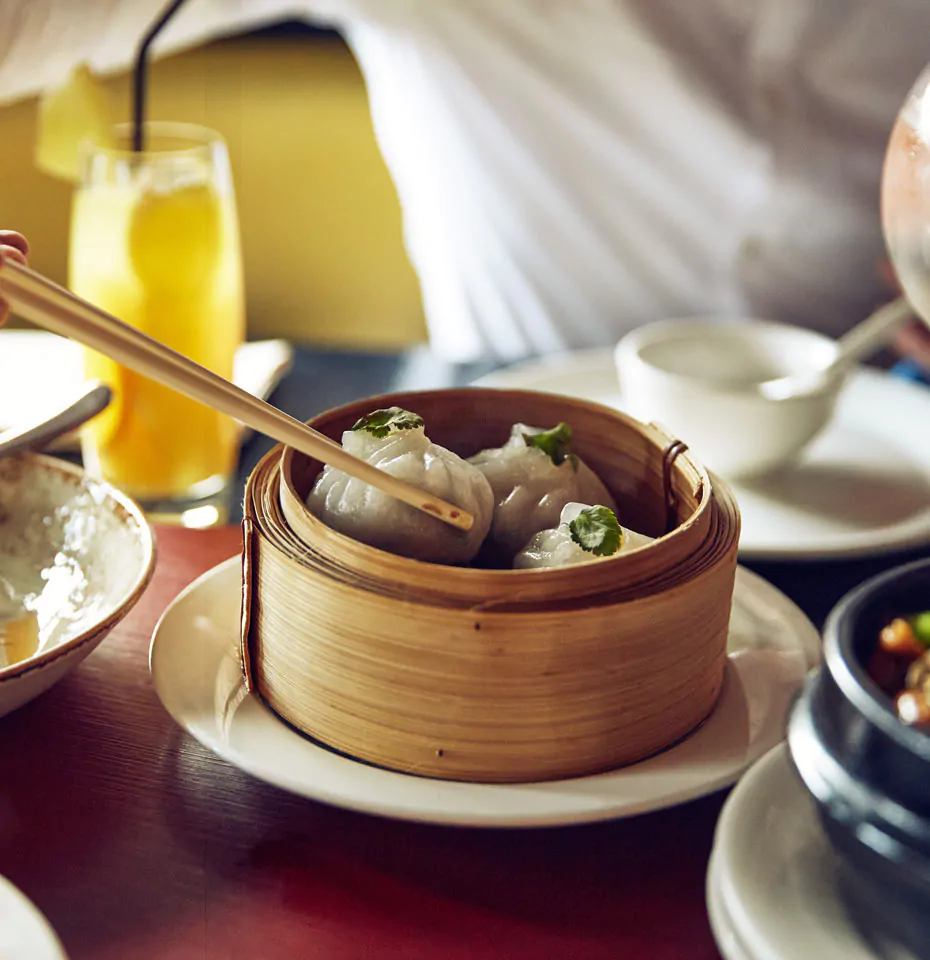
Many guests searching for vegetarian Chinese food often think of a few side vegetable dishes or tofu as the obvious mainstay. In Cantonese cuisine, it is different: there, vegetarian cooking is about refinement, balance, and technique, with vegetables that retain their own flavor and sauces that support rather than overpower.
Those who type in vegetarian Chinese Amsterdam are often looking for something practical, but discover a rich food culture along the way. At Sea Palace, plant-based food is given context: from the Buddhist tradition behind meatless meals to the role of pak choi, Napa cabbage, mushrooms, and tofu in dishes that are light, fragrant, and satisfying without becoming heavy.
Buddhist roots of vegetarian Chinese cooking
Vegetarian cooking has a long cultural history in China. A tradition of meatless meals emerged particularly within Buddhism, where respect for life and attention to simplicity come together. This did not result in a sober cuisine in the sense of being flavorless, but rather a cuisine where texture, aroma, and mouthfeel are central.
In temples and in households with Buddhist influences, vegetables, tofu, and mushrooms were prepared in such a way that they carry the structure of a dish. Think of fine cutting techniques, gentle steaming, quick stir-frying, and building flavor with ginger, spring onion, garlic, sesame oil, and light soy sauce. This fits perfectly within the Cantonese tradition, where the natural flavor of the main ingredient is respected.
That background explains why vegetarian Chinese can be much more than just an alternative to meat. It is a distinct way of cooking, with its own logic. On our menu, you can see this approach reflected in dishes that radiate tranquility yet taste layered, exactly as you would expect from authentic Cantonese cuisine.
Vegetables at the heart of Cantonese cuisine
Pak choi is one of the vegetables that immediately demonstrates how refined Chinese vegetarian cooking can be. The stems remain crunchy while the leaves quickly wilt and become soft, creating a beautiful contrast. In a well-prepared dish, you taste freshness, a slight bitterness, and sometimes an almost nutty undertone.
Napa cabbage also plays a major role. This cabbage has a mild, juicy character and absorbs flavors easily without losing its own identity. In stir-fries, braised with mushrooms, or lightly blanched with a fragrant sauce, Napa cabbage shows why it has such a permanent place in Cantonese cuisine.
Mushrooms are at least as important. Shiitake provides a deep umami flavor, oyster mushrooms bring meatiness without the meat, and there are other varieties that provide a soft, earthy tone. For many vegetarians, this is one of the surprises of vegetarian Chinese; it is not about missing something, but about the full role that vegetables themselves can play.
Tofu is not a single ingredient, but a family
Tofu is often mentioned as if it were a single product, but in practice, it involves different varieties, each with its own application. Soft tofu is almost creamy and fits well in lightly thickened dishes or soups. Firm tofu is better suited for stir-frying, marinating, or frying until crispy, as it retains more structure.
There are also drier or pressed forms that are particularly suitable for absorbing flavors. In Chinese cuisine, tofu is often used not just as a meat substitute, but as an ingredient with its own character. This means that the preparation is more important than the question of whether tofu is “exciting” enough on its own, as it only becomes so in combination with the right sauce, vegetables, and heat.
An interesting detail is that in many cuisines, tofu is treated like a sponge, while better preparations show that tofu also has its own flavor and mouthfeel. Brief steaming, careful stir-frying, or simmering in cubes ensures that tofu does not become unnecessarily dry or rubbery. In a well-executed vegetarian Chinese dish, tofu is therefore not a compromise, but a conscious choice.
Dim sum as a plant-based tradition
Anyone who thinks that dim sum is primarily about shrimp, pork, or chicken is missing a large part of the story. Dim sum is a brunch and lunch tradition in which small dishes together form a meal, and plant-based variants have been part of that for generations. It is about sharing, tasting, and lingering at the table, often with tea.
At Sea Palace, this tradition fits beautifully with the rhythm of the day. Amidst the floating pagoda architecture, the view over the Oosterdok, and the location within walking distance of Central Station, you can see dim sum as a relaxed way to experience vegetarian Chinese food. The dishes do not arrive at the table as hurried snacks, but as a series of subtle flavors and textures.
Plant-based dim sum can consist, for example, of steamed vegetable dumplings, buns with mushroom filling, or other handmade snacks where cabbage, glass noodles, and herbs come together. This complexity makes dim sum interesting for vegetarians, but also for groups where not everyone eats the same thing. In this way, a lunch immediately becomes a shared experience instead of a collection of individual choices.
Specific vegetarian options at Sea Palace
At Sea Palace, you will find vegetarian dishes that align with the Cantonese way of cooking: clear, precise, and without unnecessary fuss. Think of vegetable dishes with pak choi or Napa cabbage, preparations with mushrooms and tofu, and dim sum options that are handmade and perfect for sharing. The menu shows that vegetarian Chinese food can be more than just a standard side dish.
For a dinner at the table, it works well to combine different flavors. A dish with crunchy vegetables alongside a soft tofu preparation and a steamed dish with mushrooms demonstrates the breadth of the cuisine. This is particularly pleasant in a group setting, as everyone can enjoy the meal without the vegetarian guest feeling restricted.
Sea Palace is also a logical choice for groups, families, and cultural occasions where food plays a social role. The spacious layout, the quiet craftsmanship in the kitchen, and the waterfront location give the meal a certain naturalness. You don’t just come for a plate of food, but for a table where multiple generations or circles of friends can gather at once.
Flavor, technique, and why vegetarian isn’t boring
The idea that vegetarian food is boring often arises when vegetables are overcooked or too heavily sauced. In Cantonese cuisine, the opposite happens. Vegetables are heated briefly so they remain fresh, and sauces are used to connect, not to hide everything.
This also changes the way you taste. You pay more attention to the firmness of a mushroom, the juiciness of Napa cabbage, and the gentle sweetness of a lightly caramelized vegetable. Vegetarian Chinese food is about contrasts—for example, between steaming and stir-frying, between tender and crunchy, and between earthy and fresh tones.
This makes this cuisine attractive for those who eat consciously, but also for those who simply want to enjoy a delicious meal without meat. The richness lies not in a large quantity of ingredients, but in the precision with which they are treated. Once you taste that, you quickly notice that vegetarian food in a Chinese context is not on the sidelines, but at the heart of the kitchen.
Vegetarian Chinese food at the Oosterdok
Sea Palace is part of the Amsterdam cityscape, but also part of the daily practice of mindful eating. Our floating pagoda-style restaurant is easy to find from Central Station, the Public Library, and NEMO, making it a great fit for a lunch or early dinner during a walk. For those seeking vegetarian Chinese food in an environment that feels calm and prestigious, it is a pleasant combination.
The setting also helps you appreciate the food. On board our floating restaurant, you look at a meal differently than in a quick takeaway setting. You have the space to taste, share, and notice how dim sum, vegetables, and tofu each have their own place within Cantonese cuisine.
That is precisely the charm of vegetarian Chinese food at Sea Palace: it is careful, versatile, and rooted in a tradition that takes plant-based food seriously. View the menu, choose a table at the Oosterdok, and take the time to taste how rich vegetarian Chinese dishes can be.
Frequently Asked Questions
1. Does Sea Palace have good options for vegetarian Chinese food?
Yes, Sea Palace offers various vegetarian dishes within Cantonese cuisine, with vegetables, tofu, and dim sum as permanent pillars. The emphasis is on fresh ingredients, quick preparation, and a natural balance of flavors. As a result, vegetarian dining here feels like a complete experience, not a fallback option.
2. Is vegetarian Chinese food the same as vegan Chinese restaurant food?
Not always. Vegetarian excludes meat and fish but may still contain egg, dairy, or other animal-derived ingredients, depending on the dish. Those who wish to eat entirely plant-based are advised to ask specifically about vegan possibilities or to check the menu carefully.
3. Which vegetables are commonly found in vegetarian Chinese food?
Pak choi, Napa cabbage, and various mushrooms are very important in Cantonese cuisine. They provide freshness, juiciness, and umami, giving a dish sufficient depth without meat. Bean sprouts, broccoli varieties, and leafy greens also regularly play a role.
4. What makes dim sum suitable for vegetarians?
Dim sum consists of small dishes that you eat together, providing plenty of room for plant-based variants. Think of steamed dumplings, buns, and other snacks with vegetables or tofu. It is a pleasant way to taste different flavors without being tied to one large main course.
5. Can I visit Sea Palace for a vegetarian group lunch or family dinner?
Yes, vegetarian Chinese food is particularly well-suited for groups and families because many dishes are meant for sharing. You can combine multiple platters to create a varied table together. This fits well with the calm, spacious atmosphere of Sea Palace at the Oosterdok.
6. How do I recognize tofu in Chinese dishes?
Tofu can appear in many forms, from soft and creamy to firm and crispy. Sometimes it is clearly visible as cubes; sometimes it is incorporated into a dish with vegetables or sauce. The shape says a lot about the preparation, as the texture often determines how the tofu carries the flavor of the dish.
7. Do I need to make a reservation for vegetarian Chinese food at Sea Palace?
Reserving is wise if you are coming with a group or want to eat at a busy time, such as during the weekend or around holidays. This ensures you can sit comfortably and share the meal at your leisure. This is especially pleasant for a dinner with multiple generations.